Sunday, March 13, 2011

Prison Hill by Night


(shutter click!)

Oh! the wine.

In my scramble to pull the camera gear and tripod together I forgot to slip the wine bottle under my arm. In addition to forgetting my comfort beverage on this coldish night I left my clock back in the car so here I am counting each second of light exposure. 120 seconds.

(shutter release)

hmmm. A bit over exposed but I'm already one exposure deep and I aught not waste my batteries repeating the same exposure. When shooting a night panoramic one must expose each sequential picture in the same way to ensure continuity. After adjusting my camera for the next frame I start the next one. 1.....2.....3.....man that wine sounds nice about now....4.....5.....Silence on the outskirts of town is an odd mixture of engines, suburban coughing, children's screams, domestic dogs barking to one another causing a chain reaction until the entire neighborhood is laced with canine cries. Then the coyotes chime in. Continuing what the puppies had started, the the night yields to the wild dogs and their yelping, whining, barking, the neigh of a horse?? hmmm.....119......120. Click!

I begin the next photo and turn toward my car....1.....2.....scrambling down the rocky summit I carefully step on what seem to be good footholds in the half moon light....39......40.....I've made it to the car realizing I am without a bottle opener.....50.....quick thinking....55....I search through my tool bag and find a 2 inch screw.....65.....66.....phone clock......67......racing back up the large rock pile I make it to my camera, set down the bottle and close the shutter.....120.

(click)

By inserting the screw into the cork and using my Leatherman pliers I am able to de-cork the bottle and take my victory swig. Two minutes on the clock. About five more pictures to go.

The clouds are no where to be seen and the stars are out. Orion, Gemini, Ursa Minora, Draco, Ursa Majora, Polaris. Over time I can track the movement of the sky around the north star. This is what I have needed this past month, I needed to get back outside and spend some much needed time with the world.

The owl hoots then pauses. His response is heard across the sagebrush meadow.

What a perfect night to sleep out.

(shutter release)


Thursday, February 24, 2011

BLM Projects: Endemic Buckwheat Preservation

A Glimpse of the Landscape

As some of you may know, I am working for the BLM these days and for those of you who don't know what the BLM is (since i had know idea previous to getting out west), the Bureau of Land Management is one of the agencies with the Department of the Interior. The others include the Forest Service, National Park Service and so fourth. We, the BLM, specifically deal with the management of public lands and since those are hard to come by back East its no wonder why I found out about this branch of the government so recently. I'm working closely with the Carson City District Botanist in addition to four other interns to manage botanical resources in our area.

Since I started my internship about a month ago we have done much training and discussion about upcoming projects for this seasons efforts. Just to highlight the topic of most recent deliberation I want to bring up the conservation of rare plants. My supervisor, the botanist, Dean, has brought attention to a small population of endemic buckwheat plants. Endemic means that they only exist in a very specific location within the entire world (like the giant tortoises of the Galapagos), this location happens to be within our district and therefore is a species of interest to us. When a species is endemic it often means that this organism is taking advantage of certain environmental factors allow it to live in specific space. This zone of "comfort" is referred to as a "niche". Now this rare and endemic buckwheat (polygonaceae family) happens to occupy a niche so specific that it only survives by utilizing the soil made up from the silica carcasses of prehistoric aquatic microorganisms (diatoms) that settled onto the bottom of the ancient oceans and are presently exposed sections of earth. This would not be a big issue if the soils weren't of economic interest, but they are. These diatenacious soils are used not only as a highly effective component to filters of all types but more so for the main ingredient in most cat litters.

Here at the Sierra Front Office we have acknowledged this small population of buckwheat and are making efforts to preserve this plot of land from the interest of local miners. Last years interns went out and set up monitoring plots and GPS marked each individual in this population as a means to quantify the situation. Just last week we had a miner come into the BLM district office to inquire about that plot of land that is so precious to us. This man has millions of investment dollars to set up a new "cat litter" mine but since the land is not yet officially preserved we have to wait for the higher ups to make their decision. Sadly in Nevada there are some very powerful laws backing up the miners to stake their claim, these laws pre-date the endangered species act and take no such consideration. With little preventing the miners form taking over we can only continue to monitor the area and hope the land is preserved in time to save our precious buckwheat who will have nowhere to go outside his niche.
Oh my... Each day I see how managing natural resources on the public lands is so difficult. We must conserve but also meet the needs of the People!

It is their land you know.

Sunday, February 20, 2011

For the Love of Film


After two weeks of waiting for my roll of black and white film to be developed, I have results! I first loaded the film on the day before I made the long and somewhat lonesome journey across the country to Carson City Nevada, my new home for the next 10 months. Since it has been nearly a month since I left home, I have been long awaiting these exposures. Unfortunately it took so long because the camera shop I chose (likely the only one in town) sends its film all the way to Los Angeles for development, I was trying to keep it local but film seems to be on it's way out. Below are a few of my exposures, more can be found through my Flickr link on the right. Sadly my 35mm has been acting up (as elderly cameras often do) so I won't be exposing more film anytime soon, until I can get it cleaned and lubricated. I still have my digital so dry those tears, its OK.

A shot of the intern crew working out in the field

Our storage cage. There are some great toys in here!

Biking my way home, this was taken before my tire blew out...

Thursday, December 16, 2010

Winter Ascent


We dropped our tools and decided to go for a hike the next day.

We hit the summit of Camels Hump in the Green Mountains of Vermont this week and were fortunate enough to receive fresh tracks in the snow during our hike. It makes the going a bit tougher but being first to break trail sparked an interesting feeling of adventure. we trudged through the snow in what appeared to be untouched wilderness. The summit was windy and freezing but I managed to snap a few pictures before my hand completely froze. after my 2 weeks of sickness, it was nice to finally get outside. For some reason I overlooked the option of venturing out of doors, forgetting the healing power of natural exposure.

I love hiking in the winter for many reasons:

The views: Although most of the time the summit is clouded in a snow squall yielding no view, just harsh winds and low temperatures, those days when you do end up having a clear summit the snow dusted landscape to behold is like no other.

Temperature control: When hiking in sub freezing temperatures you will find that if you have sufficient layers, the simple shedding and addition of them can keep you quite comfortable. When hiking in the summer you have to deal with both the insects and temperatures beyond your control.

Hiking down: This is often the best part as long as your knees, hips and back are in good shape. With the trails covered in snow and being quite slick you can often slide down the mountain in many ways: on snowshoes, rain pants, sleds, or skis. These are all great ways to make the descent more enjoyable.

I'm not a fan of the self oriented head shot but I don't think anyone else was about to risk their fingers in that cold.

Thursday, November 25, 2010

Tuesday, November 23, 2010

Navigating Zion


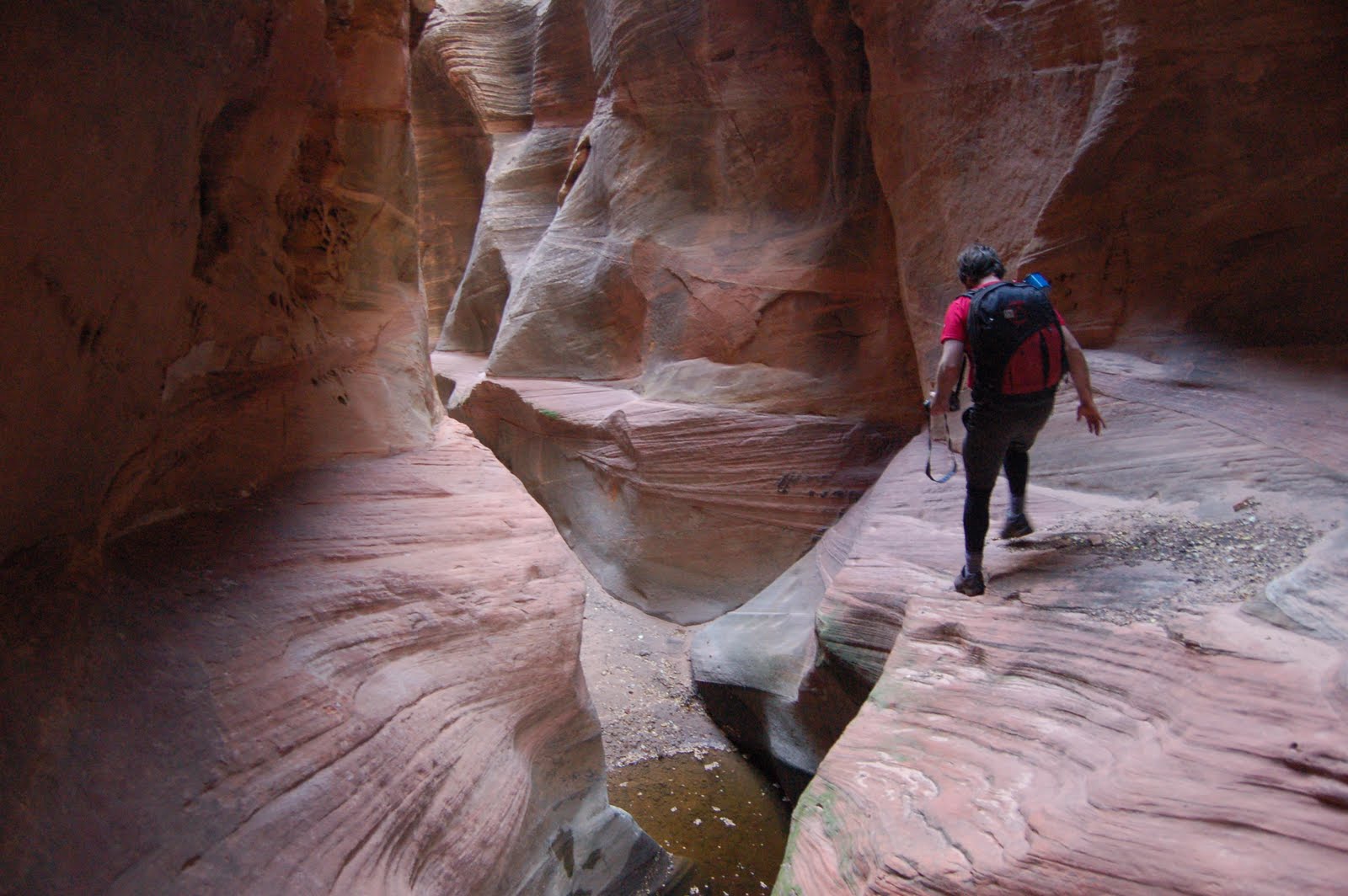
On a beautiful November day we hiked though Zion national Park. It was both warm in the sun and cool in the shade that day. While trekking along after our night in the back country, we peered down off the side of the trail into a gorgeous and tempting slot canyon. After last nights amazing views off of Cable mountain, where the vista sat atop a 2,000ft vertical cliff, we weren't quite ready to close the trip.


After sizing it up, we back tracked a little ways and found an access point at which we could enter the slender narrows of this innocent canyon. from the trail we could see the dry river bed below but when we entered the canyon we were somewhat surprised to see that we must cross a small body of water to continue. After piling a few stones in the shallow pool we managed to cross with our heavy packs and cameras in hand.

Continuing onward, the highly photogenic canyon was quickly bombarded with the clicking of our SLR's and awe struck gazes. rounding a few corners we reached another, larger pool of water. Thirsty for adventure, we climbed up onto the walls, where a steep ledge allowed us to jump from side to side across the narrow waterway with only the slightest bit of hesitation.

Once all three of us, and our packs were safely across the lagoon we blazed the trail onward with high spirits. Just past the curving slender walls we were frustrated to see yet another, much larger body of water with what seemed to have no end to its depths in sight. looking back momentarily we realized that the final leap from our last obstacle made heading back near impossible. The vast expanse of water ahead of us made my heart sink into darkness, just like the rocks we tossed while testing its depth. standing in contemplation we noticed actual trail winding above us on the rim, so we heard the occasional hiker comment "oh look they're doing that canyoneering he spoke of" likely referring the the park ranger who told them how complicated and dangerous the activity was. Feeling somewhat amateur, we continued to ponder the situation at hand: getting out before the rangers stop by and force feed us variations of "I told you so".

luckily with Orion being such an agile problem solver and the canyon being so narrow, he set out across the water by propping himself against the two walls using hand and foot. After a period of negotiating the curvature of the walls he managed to climb up and onto the trail where through a couple of failed attempts we threw up some rope so that he could haul our packs up and out.

Looking again to the path ahead of me I couldn't even fathom attempting what Orion had done. Doubting that the water was deeper than 6'5", I striped down, held my pants and boots in a bundle over my head, and placed my feet into the frigid water. Once at waist depth, I saw the brighter side of my cold, tiresome situation: this was the closest thing to a shower I had had in countless days of traveling and trekking. Continuing, I waded through two additional pools before finally getting to the outlet into a much larger canyon where the trail sloped down to the river bed. I turned back, standing in my white, now see through boxers, to behold a group of spectators up on the trail watching our struggles unfold. By expressing such confidence in our actions, we appeared to be legitimate adventurers.

As soon as Mike finished assisting Orion with sending our packs up the canyon wall he followed my lead through the mucky waters and we made it out intact, aside from my camera, which suffered a fractured detachment from its lens during a toss of my pack. Nothing a little superglue won't likely fix. Later that night we met up with some of our travel friends, Sir. Williams from the UK and Mike from Illinois. We feasted around a campfire with a protein filled dinner of steak kebabs and exchanged stories from our travels that day.

Coming Into Focus

It can often be a struggle to obtain the desired focal range when exposing photos at night. I enjoy how these photos flex my patience.